
The Difference Between Handwriting and Typing on Memory and Retention
Do you notice a difference in your memory, organization, or recall when you are physically writing using pen to paper instead of typing? I do. I personally notice a big difference, especially when emotions are involved.
We often view the act of writing as just a simple output skill or a way to record thoughts. But what if there is something more to it? What if I told you that what is happening inside the brain during the act of writing tells a different story. Writing by hand and typing on a keyboard are not neurologically equivalent activities. In reality they engage the brain in strikingly different ways. Particularly when the material being written carries emotional meaning or is important for learning.
Writing and the Brain
When you write with pen and paper, multiple regions of the brain are activated in a specific and integrated way. This is because the act of handwriting is a complex, multi-sensory task that combines movement, memory, language, and attention.
One of the many key areas involved during the act of writing is the prefrontal cortex, which is responsible for decision-making, focus, and organizing thoughts. As you put your pen to paper and form each letter, this region helps you slow down and process what you’re writing more deliberately.
Another area that is heavily engaged is the motor cortex. Unlike typing, where muscle memory is responsible for the same repetitive keystrokes used without much thought, handwriting requires fine motor precision for each individual letter shape. This exercise strengthens the neural pathways associated with coordination and learning.
Another critical region is the hippocampus, which plays a central role in encoding new information. Studies have shown that writing by hand enhances memory retention because the brain is actively constructing meaning rather than passively recording it.
The somatosensory cortex, which is the area of the brain that processes tactile information, also comes into play as it processes the tactile feedback of physical writing on paper. This sensory input reinforces learning by connecting abstract ideas to physical experience.
Perhaps most importantly when emotion is involved during handwriting the amygdala becomes more active. Writing something meaningful like a personal reflection, a goal, or a struggle creates a stronger emotional imprint, making the information more memorable and impactful.
Typing and the Brain
And now let’s talk about typing.
Typing may be more efficient, but it is far less engaging as it activates a narrower set of brain regions. The process becomes more automatic and less cognitively demanding especially over time as typing becomes more habitual.
Typing still involves the motor cortex, but in a more repetitive and less differentiated way. Pressing keys doesn’t require the same fine motor variation as forming letters by hand.
The prefrontal cortex is also still engaged, but to a lesser degree because typing often encourages speed over reflection. This can reduce depth of processing, particularly when taking notes or trying to learn new material.
The hippocampus shows significantly less activation during typing compared to handwriting. This is one reason why people often remember less of what they type versus what they have written by hand.
Emotional engagement is also typically far lower as the amygdala is less likely to be strongly activated unless the typist is deeply focused and intentional. Over time, typing becomes mechanical, letters appear on the screen and make words without the same level of personal connection.
Why This Matters for Learning and Emotional Connection
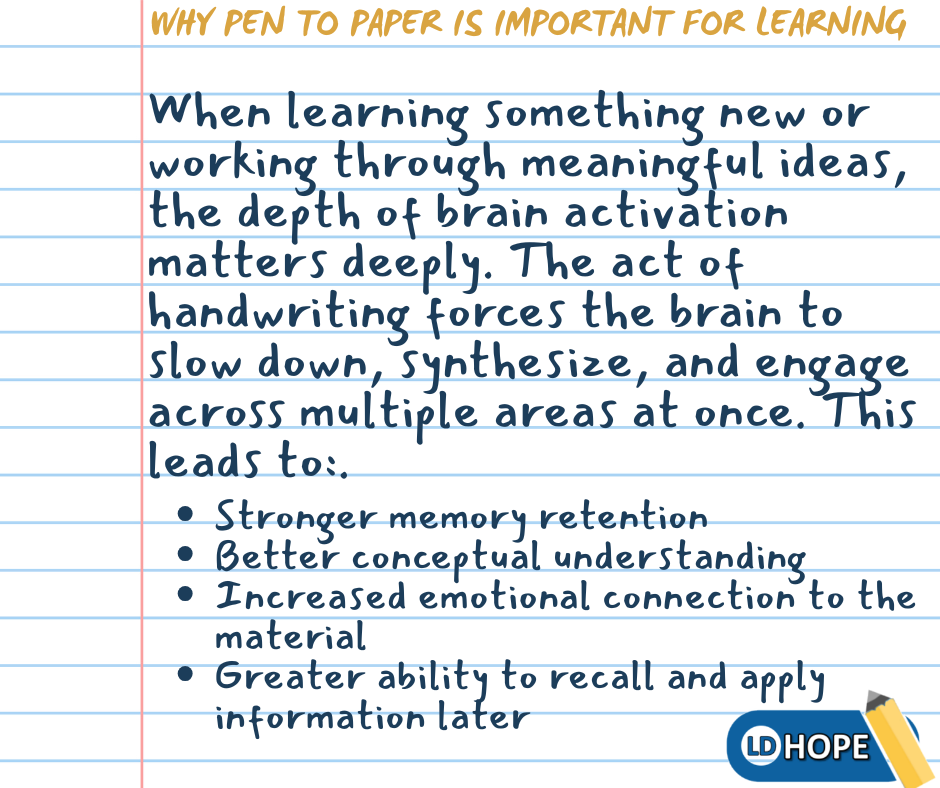
When learning something new or working through meaningful ideas, the depth of brain activation matters. The act of handwriting forces the brain to slow down, synthesize, and engage across multiple areas at once. This leads to:
- Stronger memory retention
- Better conceptual understanding
- Increased emotional connection to the material
- Greater ability to recall and apply information later
Reference: https://pubmed.ncbi.nlm.nih.gov/38343894/
Handwriting but not typewriting leads to widespread brain connectivity: a high-density EEG study with implications for the classroom
Typing, on the other hand, is excellent for speed, efficiency, and volume but often at the cost of depth.
What is the Takeaway?
If the goal is to truly learn, process, and / or connect with what you’re writing, putting pen to paper offers a neurological advantage. Handwriting isn’t just an “old-fashioned” skill, it is one of the most powerful cognitive tools to activate the brain in ways typing simply doesn’t replicate.
That doesn’t mean typing has no place as it clearly does, especially in this day and age. But when something matters, especially when it’s personal, emotional, or essential for learning slowing down and writing by hand can make a measurable difference in how deeply it is understood and remembered.
Amy is a Christian mother of three amazing adults, a small business owner, and the director of student services for Essential Learning Institute. Her passion is helping children who are struggling to learn, find, and reach their potential. Her daily motto is, “Find the joy in your moments”